Miley Cyrus - Wrecking Ball
This is an iconic example of sexism in a music video and the media industry. First and foremost, the actual song lyrics and the message conveyed could be interpreted as representation of a patriarchal society where she is exulting male dominance in relationships in the sense that she is at the mercy of the male she is singing about suggesting that he had the power in the relationship and then when she challenged this power, he walked away leaving her in bits.
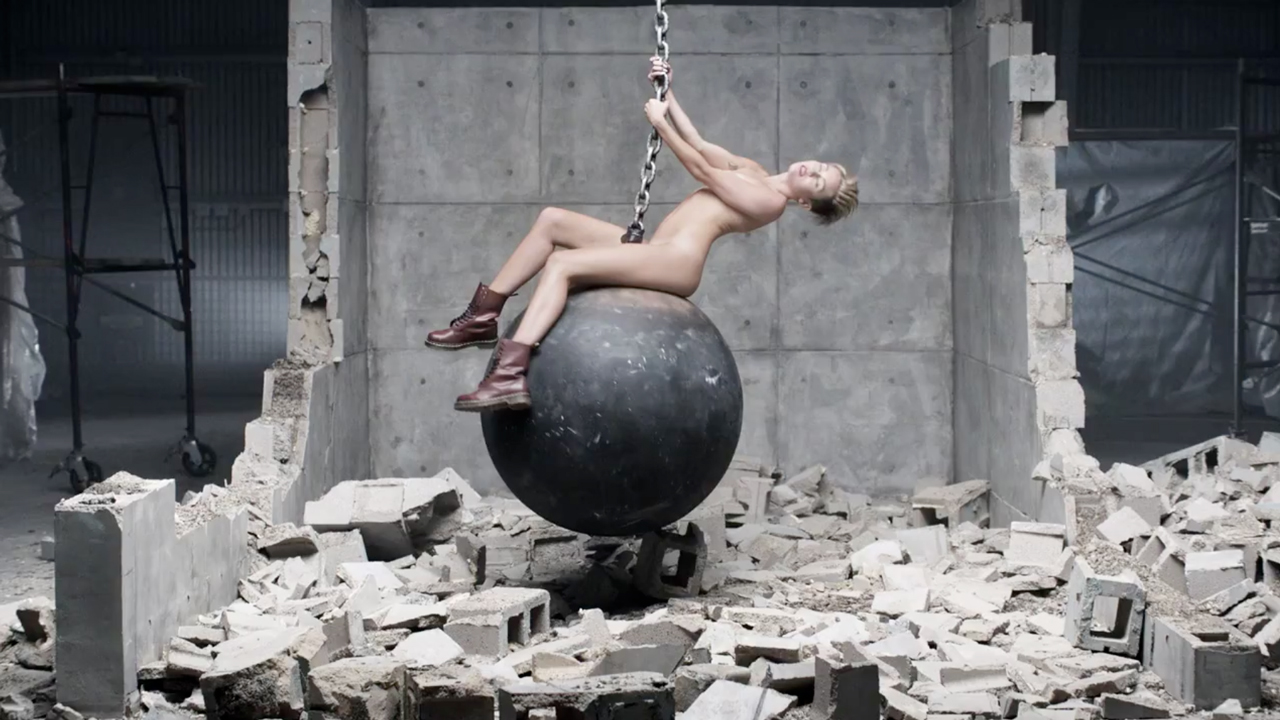
Furthermore, the video is extremely sexualised and conforms to Mulvey's theory of the male gaze, the very basic studio setting of the video and the often white and grey background forces the audience to view the video firmly focused on Miley swinging on the huge wrecking ball. The high level of nudity and the fact that Miley is often centred in the middle of the camera suggests that the creator of the video wanted to emphasise the erotic sensations resonated from Miley and her relationship with the camera and audience.
Contrast


There is a big contrast to Miley Cyruses' image as Hannah Montana in comparison to her new image within the music industry. It is suggestive of the idea that the music industry 'prostituted' Miley and created her this image to show her transition from a young and innocent girl to a woman. However, this as been a carried out in an extremely sexual and objectifying way and other ways could have been used to make Miley look more like a woman without having to be outrageously sexual. This suggests that the media sexualises women and females are supposed to adsopt a sexual and erotic personna in order to be successful within the industry. Consequently, these women come under scrutiny by critics based on the sexual exposure within their music videos. This would conform to theories such as that of Laura Mulvey further and this sexual depiction of women is in correlation to the fact that there only 16% of females are media practitioners which suggests that these sexual depictions are heavily determined by male directors which would support the idea that the media industry is sexist and male dominated.
Robin Thick - Blurred Lines
Robin Thick - Blurred lines is an outrageous example of sexism in the media. The fully clothed men are paraded around by completely nude women who are holding themselves in a very sexual and provocative way. This video more than any other music videos related to sexism speaks for itself. It is outrageously sexist and completely and wholesomely objectifies women. This music video conforms thoroughly with the theories of Laura Mulvey who developed the Male Gaze where the camera sexualises the woman and the audience are forced to identify with the perception of the Male while watching the media text which relates to the theory. Also, the camera watches the male antagonist admiring the sexualised woman who normally does not have agency within the media text watched on screen.

The use of various different shots ranging from long shots to close up shots of the women are effective in correlation to the simplistic studio setting of the video where the emphasise is drawn upon the nudity of the women. The way these three different factors interact with each other throughout the video forces the audience to identify with the sexualised women and view this from the male perspective further giving emphasis to how Laura Mulvey's theory of the male gaze and patriarchy within the media.

Lilly Allen - Hard Out Here
Lilly Allen's video Hard out here is a very controversial video that addresses problems in the medium and especially inequality and sexism within music. The video is a paradox where Lilly Allen is sending a message to the audience showing how things need to change as there are female supporting dancers being extremely sexually provocative with their dance moves which is a depiction of the common day pop or R&B video and addresses these stereotypes. Although the song conforms to the theories of Laura Mulvey in the sense that it is identifying what is wrong with the depiction of women in the media the video is very different and subverts from this theory and women are being sexualised through their outfits and dance moves. Despite this, the video is unique in the sense that the overall message is that what the girls are doing in the video is not necessarily wrong, but it is a constant thing where women are being sexualised in the media and are being depicted as objects of erotic desire.

There are a variety of camera angles used by Lilly Allen's director to again put emphasis on the sexualised nature of the video and the dance movements of the females within the video. There are many close ups on the backsides of the dancers as they move them in a sexualised way. This cultivates feelings of erotic desire for the male audience and the female audience are forced to identify with this and may feel degraded by these shot techniques in the portrayal of women.
Laura Mulvey - Male Gaze
The stem of this theory is that the depiction of women through the camera in media text is from the male perspective and the audience is forced to identify with this perspective which means that they are forced to view women as objects of erotic desire. Furthermore, if the audience do not directly view women as objects of erotic desire then they are identifying with the perspective of the male protagonist who views the female as an object of erotic desire. A good example of this is transformers where Shea Lubuf views Megan Fox as an object of erotic desire for the women to view;
Despite the depiction of women, their presence in media text is essential. They do not normally have much agency in the media text or film but their importance stems from how they make the male character act or feel which helps develop the plot.

Male Gaze and Hegemony
Hegemony is societies perception of the dominant groups in a social or political context. It shows the dominance that subordinate groups obtain over insurbordinate groups. Examples of Hegemony is the upper and middle class dominance over the working class. This relates to sexism in the media and Mulvey's theory of the male gaze based on the fact that it suggests within media texts, the male dominance is shown over the female characters. This results in women objectifying other women Mulvey argues, and this then puts pressure on society even more where women are always sexualised within the media and because there is so much media around for people to view, women feel that they need to look and feel a certain way to accpeted by society.

Visual pleasure and Socophilia
Characters that look at other characters within the media text are active and the characters which are being viewed are often female and less important. It is often suggested that women slow down the narrative and act as inspiration for the male protagonist to act. Men on the other hand move the narrative forward and make things happen which gets them viewed as active.

Socophilia translates into 'the love of watching' and relates keenly to objectifying within the media. Movie and film have often been related to Socophilia practices and the idea that women are objectified within the media. The term derives from Freud's study of the psyche and is a key term in referring to the media.
Patriarchy
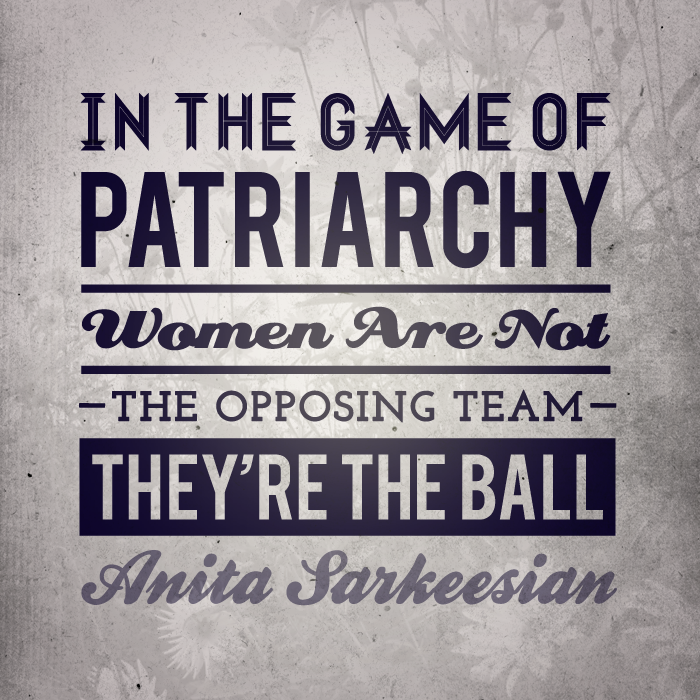
A patriarchal media representation is another theory designed by Mulvey which relates to the idea of a dominated society by males where they set the majority of the rules and construct and represent the ideal visions, roles and male dominance over women. The worry about this concept is the fact that if it sustains then the socophillic audience will harbour these ideas and it will turn into reality in society if it has not already.
Anaconda - Nikki Minaj and the significance of Black women in the sexualised media
Nikki Minaj's Anaconda video is a highly sexualised video and it can be keenly argued that it is sexist ranging from the song through to the content of the music video. Starting with the mise en scene, Nikki and her supporting dancers are highly sexualised and objectified making them stimulating to watch as objects of erotic desire and as Mulvey would argue, de-humanising the women. There is also a high amount of Phallic symbols where we witness banana's rotating on the record player and also Nikki Minaj eating a banana herself. There are short and fast paced camera shots and dynamic angles to contribute to the seductiveness of the video and encapsulates the idea of sexual chaos. To further support this, the video has an illustrative persona where the lyrics of the song relate strongly to the visual aspects of the music video and are suggestive of sexism and sexual objectification of women to an even greater extent then that of the actual video.

To further assess the idea of sexism within the music video, nearly all of the dancers that are being perceived as erotic are black. This is suggestive of the idea that, especially within music videos, black women are more regularly sexually objectified than women of other ethnicities. A significant contributing factor to this is the fact that the rap music is very derogatory towards women often using terminology such "bitch" and "Hoe" to describe them which is companioned by women, mostly black women, being sexualised in rap music videos and objects of erotic desire to prance around the male rappers.


No comments:
Post a Comment