
Rockin Robin - 1971 - First music video
Rockin Robin is a great example of the simplicity of Pop music videos in the 1970's and is a good starting point to assess how Michael Jackson's videos have progressed and developed in technology as more digital technology has emerged and evolved to aid the complexity and dynamic of music videos. There are many features of Goodwin's theory of the music video as the band is notoriously known as the Jackson 5. They are performing on stage in a studio we assume to the audience which corresponds to with Goodwin's idea that Pop music videos involving group artists are often seen performing a dance routine or on stage to the audience. The video is very basic and shows how when Pop music was just beginning to emerge as a major type of music, the music video that would help promote it was simplistic and easy in nature.
Rock with You - 1979
There is a distinct difference between 'Rockin Robin' and 'Rock with You' over the course of 9 years. The lighting is exotic and impacting on the audience in this video which is accompanied by the stylised and outstanding outfit of Michael Jackson. This shows the slight development of digital technology and style of the music video over the period of the 70s where lighting is used more effectively. This video also conforms to Goodwin's theory of the Pop music video where Michael Jackson is performing to a digital audience in relation the camera.
Billie Jean - 1982
Billie Jean was the first pronounced music video where there was a storyline that accompanied the music of the track. It also shows developments in technology in comparison to his previous videos. The use of the lighting up of everything Michael touches is not only illustration of developments in technology but presents the story that Michael is innocent and not liable for impregnating "Billie Jean" and the lighting up of everything that he touches illustrates his innocence. This illustration within the music video means that this video again conforms to the theory of Goodwin where music videos can illustrate the lyrics of the song and show the meaning behind the lyrics.
Beat It
Beat it is another iconic Michael Jackson video that employs choreography and performance within the video while telling a story at the same time. This shows that the lyrics are relating to the action on screen and therefore conforms to Goodwin's theory of illustration and performance within the music video specifically in the Pop genre. The video also gives a message to the audience that violence isn't the answer and the violent nature of the two gangs is juxtaposed to the choreography towards the end of the video which suggests dance should replace fighting. Michael Jackson appears the peace maker and the men begin to follow him in dancing which again exults Goodwin's idea of the record label presenting and conveying their artists in specific ways. This was one of first videos that had major choreography in it and is a milestone and reference point for future Pop music videos.
Thriller
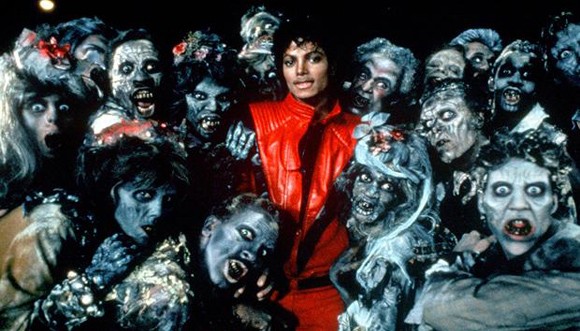
Thriller is considered the most famous music video of all time and the first to adopt the storyline style to the music video. In 2009, it was added by the Library of Congress to the National Film Registry which makes it the first video in their registry.
Cultural Milestone
The video is undoubtedly a cultural milestone in the history of music videos with the correlation of choreography in music videos, exotic costume and dialogue and extended movie style music video that is edited down to allow the video to be screened on TV. Noticing the longevity of the music video, MTV created a short version of the music video which ran a little under 5 minutes to accommodate the fast flowing nature of music television. Despite this, the main 13 minute long video racked in 100 million views on YouTube when it came out.
The video cost $500,000 to make and Jackson's record label had no intention of paying for it since the album was on the downswing and they had already financed two videos for his album. Michael was adamant that he wanted to turn into a monster and agreed to pay for it himself in order to make it happen. Jackson's director, John Landis took on the project as he saw it as a way to revive the short film genre which he loved.
Jackson did not have to pay for the video because he landed big deals with Showtime TV and MTV who paid for the video and in return be the first to air the video and a behind the scenes documentary of the "Making of Thriller." MTV deemed it unacceptable that Showtime were to broadcast the video before them and so Pittman decided that he was going to pay out £250,000 to broadcast the video after the window was up. MTV were not used to paying for videos so they said they were paying for the documentary film when really they were paying for the music video itself.
1984
At the first MTV music video awards in 1984, Michael Jackson Thriller won;
- Best Performance Video
- Best Choreography
- Viewers Choice
The music video majorly started off a trend seen in music videos to follow with group choreography prominent in Pop music videos from thriller onwards. The video also owes a debt to Alice Cooper who created a music video in 1975 based on Welcome To My Nightmare tour which was written was Vincent Price. Cooper's production was based on a full album but had the theme of a horror and thus she felt she needed compensation from the video.
From 1983 people were able to watch VHS recordings at home people were able to watch Thriller at home which included the 13 minute video and the behind the scenes making of Thriller. This music video became the greatest selling music video of all time and was later certified by the guiness book of world record as the best selling music video of all time pulling in 9 million units. This was majorly assisted by the time the video was released being just weeks before christmas.
The style of the music video being both a short film and a music video means that there is so much involved in the production. The use of the camera interlinks traditional cinematography with music video stylised editing. The short film is of a horror genre which correlates with the music and meaning of the track, this therefore means that the Thriller video conforms to the theories of Goodwin where the music video is illustrative and tells the story of the song. The choreographed routine performed is a trade mark in pop music and is classic. The mise en scene is used very effectively by the director where the costume is very disturbing and intimidating which meets the intentions of the vidfeo where they want to make the audience feel uncomfortable and freightened. Overall, the music video is very iconic and has great impact on the audience and incorporates a range of features that make up a classic pop music video.
Bad
Bad is another iconic music video of Michael Jackson which was the first after the major track of Thriller. The audience was excited to see Michael's new image as they had seen within the media that he had changed his image. By now, Michael was the biggest Pop star in the world and this video was first aired on the BBC.
The music video adopts a performance based persona and Michael can again be seen wearing a fashionable and unique outfit which helps exult his image as a Pop star. The music video is also very illustrative where they are dancing within a car park which is notoriously recognised as being a place where dodgy undertakings happen and people cause trouble in locations like this. This corresponds with the idea that Michael Jackson is 'Bad' and him and his dancers are being troublesome. As well as this, another Goodwin theory that is met by the video is that fact that there is choreography which Goodwin said is typical of a Pop music video.
The Way You Make Feel
In deconstructing this music video, it is obvious that there are features of Laura Mulvey's theories in relation to how the media represents women and perspectives of society. The woman is immediately presented as an object of erotic desire using camerawork that portrayed the sex appeal of the actress such as low level shots of her legs while she is in a pencil skirt which will appease a male spectator where they perceive the woman as something of erotic desire. The objectifying of woman is companioned by the fact that Michael Jackson is showing off to his friends in pursuit of the actress and the men outnumber the woman and make her the main source of sexual desire. In addition, Michael Jackson uses many phallic and sexual movements within his dance moves such as hip thrusting in the direction of the female actress. This corroborates the theories of Laura Mulvey and makes the audience regardless of gender identify with the perspective of the male, hence, the male gaze. Furthermore, Michael Jackson is active and has agency whereas the female is passive and does not have a protagonist purpose within the text. This relates to other theories such as patriarchy and portrays ideas within the media about society that it is male dominated and they make the rules and thus develop the perspective towards women.
Black or White
Black and White is an extremely powerful and inspirational music video made by Michael Jackson which relates to problems faced by Michael within the media and in his personal life. Despite this, it also relates to wider problems within society and gives a message to unite and bring peace between all different types of people. The video is a cultivation of diversity and the mise en scene shows Michael in multiple locations with different cultures and people promoting the notion that it doesn't matter who you are and for everyone to get along. The camera work is effective and the special effects are developed in comparison to previous videos. There are many close up shots in companionship with long shots to engage the audience and keep them riveted by the video. The small story at the beginning brings the comedic element to the song which is useful and compliments the rather serious message of the video and is also evidence of how special effects have developed from his first videos in the 70s to digital technology in 2000s. The reference to Peter Gabriel's "Sledgehammer" at the end of the video is very effective and finalises the message of the video and song. This shows how the video relates to that of Goodwin's theory where the song is illustrated by the action on screen. It also shows the unique use of camera work utilised by Michael's director and filming crew.
Earth Song
This is arguably Michael Jackson's most powerful music video out of all of them. The song and video touches on real life problems and serious topics regarding the world and lives. Real life sequences are placed throughout the video to emphasise what the message is in relation to real life. The video is also a clear example of the development in digital and CGI technology where the powerful sequences and pictures are shown such as dead animals, trees and people living in poverty. This gets the audience to think about what they are seeing on screen and receive the idea that there are problems and things might need change. This shows that the music video is illustrative and thus conforms to the theory of Goodwin in relation to music videos. It also shows contrast between Jackson's previous work where there is more substance and meaning behind his music and videos in comparison to pure performance based videos. Jackson has also been accused by critics of appearing as a Christ like figure. This is based on the fact that Michael seems to heal the surroundings which are damaged and in turmoil and the way he held himself within the trees depicts the image of crucifixion.
Scream
Michael Jackson Scream is the most expensive Michael Jackson video. It cost a whopping $7,000,000 dollars to make and today it would cost $10,834,000 to make. This an extremely high budget of a music video and helps finalise why Michael Jackson was called thking of Pop. This clearly shows the leap in technology from Michael's first video in the 1970s to this video. The mise en scene allows the video to adopt a futuristic vibe with lots of digitalised and stylistic features such as spaceships and the capture of illusion where Michael is walking on the ceiling for a period of time. An example of an iconic effect used is when it appears that Michael is in a room with no gravity and is suspended in the air.
My research
Leave me alone
This is a very interesting and dynamic video of Michael Jackson which is a good example of an amplified music video in relation to Goodwin's theories. Michael Jackson addresses issues surrounding him within the media and the video uses clever techniques to identify these. Another Goodwin theory is met where there are many instances throughout the video where there are screens within screens and Michael's face shows up on things such as Newspapers. The animated nature of the music video is efficient as it allows topics and issues Michael is confronting to be translated into effective imagery which again conforms to Goodwin's theories of repeatability and reoccurring images used to convey a certain message. This video shows the power a music video can have in the media and what messages it can send to the audience.

Where is this Blog?
ReplyDelete